
.png)
.png)


Where The Grass Remembered
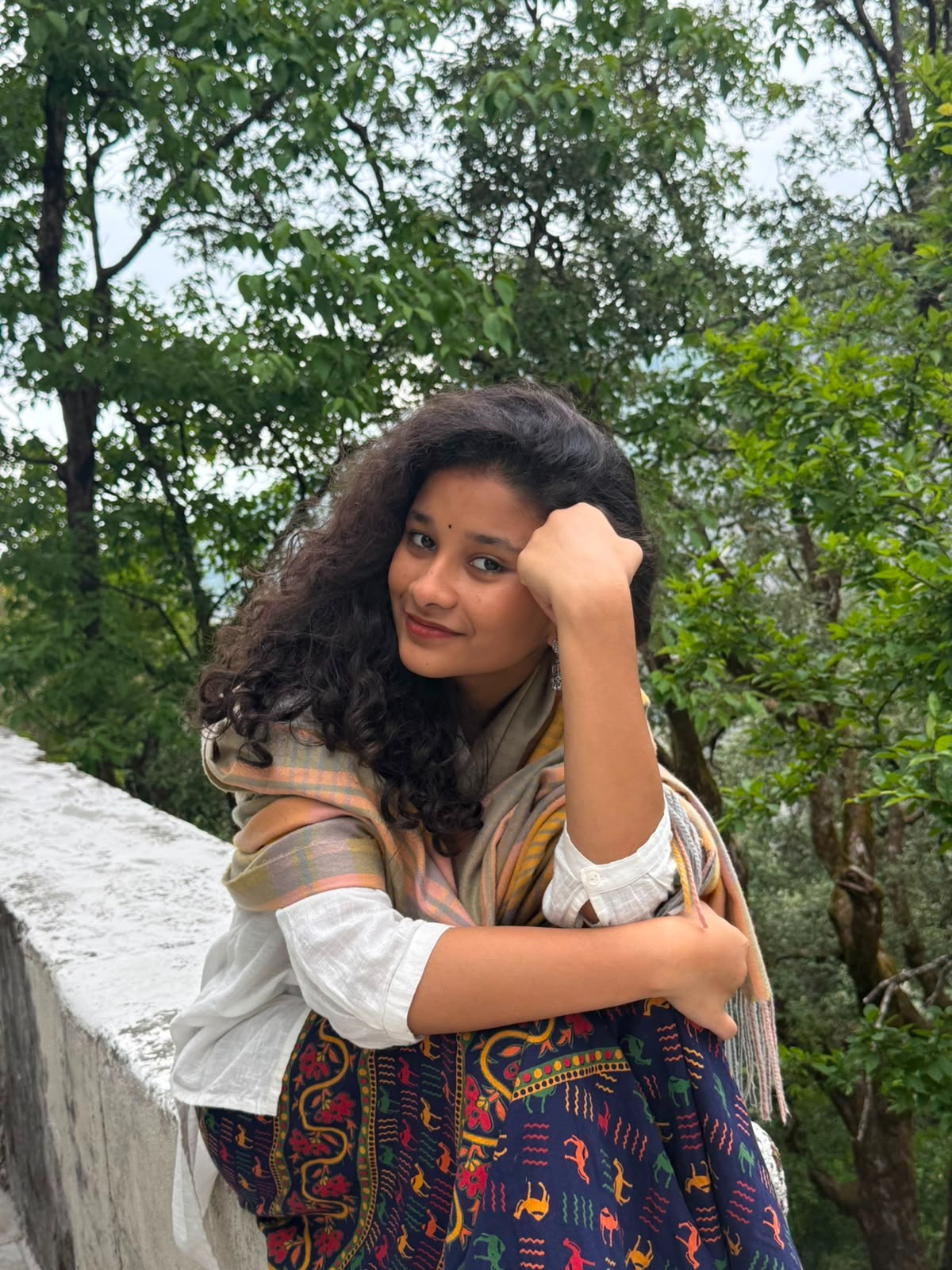
The patch of land I walked upon as a child no longer looks the same—and neither do I. The grass which used to memorise every touch has been replaced by indifferent concrete. But while I grew up, both physically and intellectually, the landscape around me quietly crumbled.

photo credits: arushi gusain
I explicitly remember the first day when I joined my father on a nature stroll; I was not only excited about accompanying my father, but I was excited about being in the lap of nature, surrounded with a familiar, yet unknown range of organisms. These strolls were about everything, from unfolding a journey of meaningful discussions, to my father taking me back and forth in time. Sometimes sharing grounds with the hunter-gatherers, and at other times daydreaming about the future.
I remember a few of our conversations very well. One of them, which has stayed with me since and continues to perplex me, is that of "evolution." Papa said, “We all evolved from apes,” and I blurted out, “All?” I was amused by the conviction in his voice, claiming that the monkeys I saw playing around could have been my age-old descendants. We hurtled through time—from hominids to sapiens—and then Papa opened another chapter called "development."
I knew what development meant, because I regularly heard my maths teacher say to my parents that "Kritika needs to develop her calculation skills more, or she will struggle in higher classes." Hence, to my young and innocent mind, development was nothing more than beneficial growth, which could help in preventing future troubles. But as we travelled through time during our strolls, we came to a haunting halt—the era of industrialisation, which significantly complicated the perceived definition and the experienced meaning of development.
Papa explained that, “It hasn’t been long since we were introduced to the era of industrialisation, but the landscape before, during, and after industrialisation tells a completely different story.” He told me how these strolls might have looked before excessive industrialisation, and I felt quite jealous of those fathers and daughters who used to stroll before that era.
From that day onwards I read and discussed a great deal about development. It seemed like a boon to the coexistence of the human race and nature in the books and discussions. Maybe, a gateway to eternal hope and health. But this optimism linked to development was limited only to books and table discussions, because gradually the nature strolls became concrete-ridden strolls, with barely any nature. I was unable to fathom this contradiction and landed in a paradox surrounding the word development.

photo credits: bhupender samra
And that is why in the midst of trees, herbs, creepers, insects, birds, and animals, my father and I found that we were awakened and lost at once—because although nature evolved, it stayed consistent with its knack to be raw—untouched by artificiality, eternal, and everywhere. Awakened, for our breathing was steady, our eyes rested on greenery, lungs swelled with delight, and mind took onto some different flight. Lost, because our conversations kept transporting us across times and places, with the nature around us as the only constant.
The tapestry of these strolls continues till now, but the pictures have changed significantly. And this change in picture is what frightens me the most. In earlier times, the pictures were about nature—the trees, the animals, the quiet coexistence of humans with them, and traces of subtle evolution. But now, the same tapestry shows pictures of land covered with heaps of garbage, dried-out water sources, and ragpicking children.
The child in me who used to accompany her father to nature strolls envied these children, for no one stopped them from being out in the world. But as that child looked more closely at their cracked soles and hollow eyes, that envy curdled into something heavier. The paradox of development, which had once been an abstract concern, now had a face.
One day, muddled up in various thoughts, I felt a choking sensation. It was growing with the wrath in me—wrath of knowing it all, but still acting unknowing. I tried to conquer that sensation, and in that quest looked out of my tiny window for a source of peace—greenery. And amidst all the dead, it was tough to find something living, striving for life.
But in the end I found it.
Breathing, like us. Coiling its way across the surroundings, as if leaving its own mark alongside mine. And regardless of all, living.
As I stared at these creepers, I felt contradictory to peace. It was something else, as though it were trying to make me see what I am already familiar with. These creepers frightened me that day; they made me feel complicit. For they may swirl, wander, and ascend wherever, without ever fearing to disturb their roots. And in that silence, my question around development had an analogous answer.
Development, I realised, was never meant to be growth alone—concrete, infrastructure, GDP climbing while everything beneath it thinned. It was meant to be something closer to what the creepers already knew: a widening of life's possibilities that never severs itself from what holds it up, an improvement that carries within it justice, sustainability, and the quiet insistence that other beings, too, have a right to their roots.
Creepers assemble themselves however they desire, carrying within them the innate reminder that their roots exist—roots that will not tolerate even the slightest threat to that hold. True progress, I understood then, could never be measured by how far a thing climbed, but by whether its roots were still allowed to breathe.

photo credits: arushi gusain
Now, whenever cracked soles, heaps of garbage, cut-down trees, and concrete forests loom in my mind, I fight them with just one picture: a narrow trail winding through the heart of the forest, where human footsteps soften the earth instead of scarring it; where homes exist without destroying another's abode; where development does not vanquish the wilderness; and where even a moth has the right to breathe freely and fully.
It is this picture that, despite all the odds, reminds me that, no matter what, you'll always fight for the patch "where the grass remembered."
Kritika Rana is a student of class 12th at Shining Stars School, Ramnagar, Uttarakhand. Having grown up in the landscape surrounding Corbett National Park, she has developed a deep connection with the region and feels a strong sense of responsibility towards understanding, exploring, and contributing to its ecological and social well-being. Deeply interested in the social sciences, she is equally drawn to the intersections of environment, literature, and art. Beyond academics, she engages with acting, theatre, dance, film, reading, and writing as ways of observing, understanding, and expressing the world around her.


What a brilliant write up ! Kritika feels and expresses in words of an evolved wise soul. I see a sterling future ahead for her . God bless !